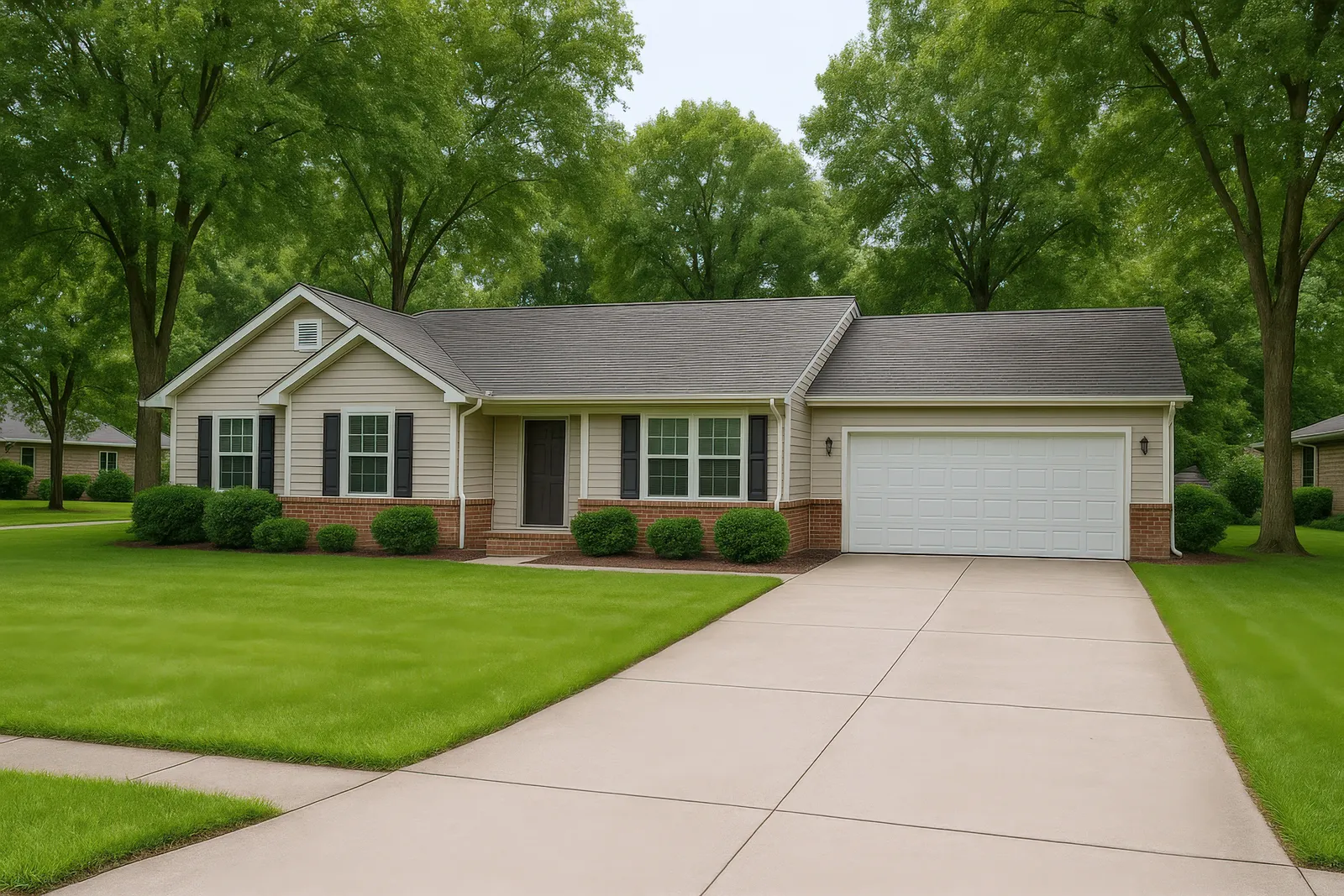
Ask what a Weatherford roof is like and one number comes back: the typical house here dates to 1982. It is true, and it describes almost nobody. A Victorian a few blocks off the courthouse square and a new build on acreage out past the city limits are both Weatherford houses, and they are not remotely the same roof. Which one you own decides what is worth doing next, and in one case it decides which government you deal with.
What the median hides
Twenty one percent of the housing in Weatherford went up before 1960. Another 18 percent went up during the 2000s. The 1982 figure sits where it does because those two ends pull against each other, not because 1982 was a busy year for building here.
Some towns east of here went up inside a single decade, and their first roofs are all wearing out together. Weatherford never did that. There is a century-old core, decades of steady building around it, and a newer ring of bigger houses mostly outside the city limits.
So there is no useful answer to how old Weatherford roofs are. There is only an answer for your own house, and it depends on which part of town it stands in. Knowing that does not mean you need a new roof, and often the answer that comes back is that there is nothing to do yet.
The oldest roofs sit within a few blocks of the courthouse
The old houses are not spread evenly around town. Most of them stand in and around the Downtown Historic District, the blocks bounded by Waco, Water, Walnut and Lee, which went on the National Register in 1990. More than 60 Queen Anne and Victorian homes from the turn of the century sit in there.
Look up at the courthouse in the middle of it, put up between 1884 and 1886: red shingles, a mansard at each end, a three story tower in the middle. Nobody is re-roofing that on a Saturday, but the houses around it were built with the same ideas at house size. Steep pitches, dormers, cut-up valleys, and flashing everywhere you look.
On a roof like that the shape matters more than the shingle brand. Water gets in at the valleys, the ridges, the rakes and the places pipes come through, and a cut-up roof has many times more of those than a plain gable does.
- Flashing and valley work drives the price: the metal details and the labor to fit them can outweigh the difference between one shingle tier and the next.
- Layers stack up: an older house has usually been roofed more than once, and nobody knows what is under there until the old roof comes off.
- Old decking is its own question: the boards under these roofs are planks, not modern panels, and some of them come off with the old shingles.
- How it looks is part of the job: a patch on a slope you can see from the street in a listed district has to match, and the same patch round the back does not.
- The estimate has to be measured: on a roof with this many planes, a number given over the phone is a guess and deserves to be treated as one.
The middle band is where 1982 comes from
Between the old core and the newest edges sits most of the town, and that is what pulls the number to 1982. University Hills, close in by Weatherford College, is one of the established in-town names. Woodland Hills, off Woodland Hills Lane, is another, built out in phases over the years.
Two things to watch here. Houses inside one subdivision out this way can be years apart, so nobody can tell you from a map what era your street belongs to. And there are two University Hills: the established one near the college, and a newer development out in the 76088 area. If a roofer, an appraiser or a listing says University Hills, ask which one they mean.
For a house in this band the year it was built is usually the wrong number anyway. The one that counts is the year the roof went on, and that is on an invoice, not a deed. If nobody in the house can lay hands on the invoice, then the honest answer is that the age is unknown, and unknown is reason enough to have somebody look.
The newest roofs are mostly outside the city limits
The newer, bigger houses are mostly outside the city limits, out on the county land that wraps around the town. Silverado on the Brazos sits on the river south of town. Canyon West runs west along I-20 across acreage lots on wells and septic, close enough that the children go to Brock schools. Crown Valley Estates gathers around Lake Weatherford on the northeast side, near enough the line to check address by address. Big lots, still building, and a different roof from the old core in every way that matters.
All three sit near Weatherford, not in it, and the difference shows up the moment somebody pulls a permit. It may not be the City that reviews it. Exposure is different out there too: a house standing alone on a rise takes wind that a house in the middle of a built-up street never feels. Wind shows itself first at the ridge, the rakes and the eaves, which is to say the edges, before anything happens out in the middle of a slope.
New does not mean settled, either. If a roof went on badly, it usually shows in the first few years, and it shows where the pipes and vents come through and at the flashing, well before the shingles themselves have done anything. So on a newer house you are not asking whether the roof is worn out. You are asking whether it went on the way the printed instructions say, because that is usually what the manufacturer's coverage hangs on, and the terms that apply to your roof are the ones in your own paperwork.
Where your own house lands, and what to do about it
Three questions settle it, and none of them need a ladder. When was the house built. Has the roof been replaced since, and in what year. Is the address inside the city limits or out in the county. Those answers place your house in one of the three groups above.
For an old house near downtown, the next move is somebody looking hard at the flashing, the valleys and the decking, not a conversation about shingle brands. For a house in the middle of town, it is pinning down how old the roof is and getting that written down if nobody knows. For a newer place out in the county, it is checking the install and then putting the paperwork somewhere you will still be able to find it in ten years.
Tell Weatherford Roofing Co about the house, and the roofer who turns up owns the inspection, the estimate, the work and the warranty, which is what you want the day a warranty question finally comes up. If cost is what you are weighing, what a roof costs here sets out the ranges by tier and what moves them, and the shingle rundown for Parker County covers where the impact-rated tiers earn their price out here.