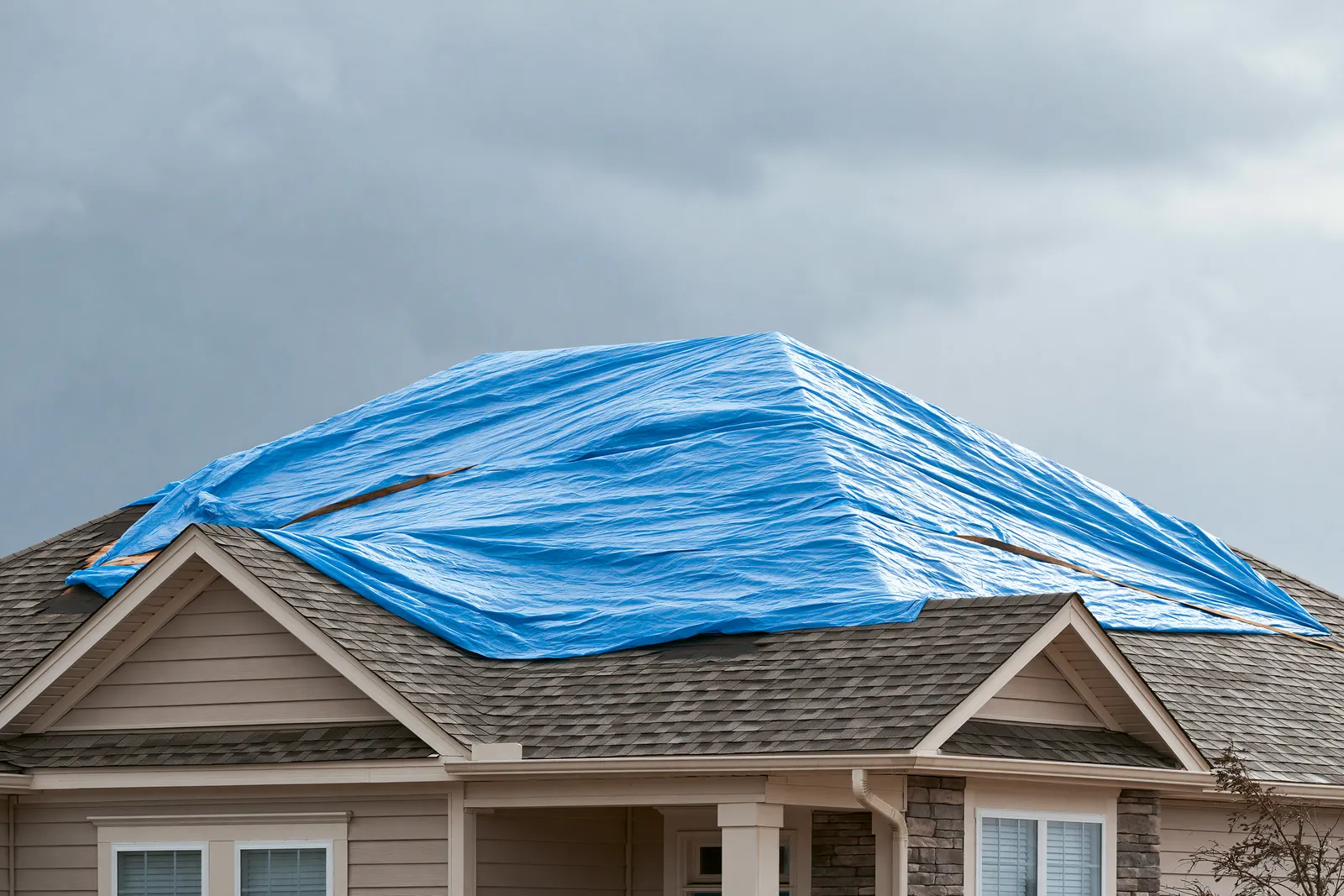
Hail dominates roofing conversation in North Texas, and Parker County has had its share since 2023: 17 hail days, 75 hail reports, 72 of them an inch across or larger, with a largest stone of three inches. Yet the two dated nights that did the most documented roof damage in and around Weatherford in that same stretch were both wind events. One of them took part of City Hall's own roof off.
The two nights the record names
Weather memory goes vague fast, so it helps to put specific nights on the table. Both of these are documented, one by a National Weather Service storm survey and one by contemporary reporting that lines up with the NOAA point data logged in and around town.
| The night | What the record holds | What it did to roofs |
|---|---|---|
| March 2, 2023 | A severe thunderstorm crossed Parker County around 5 p.m. with 70 mph winds and quarter-size hail, and five or six locations in the county logged gusts of 80 to 90 mph. NOAA points tagged at Weatherford log 70 mph and 75 mph straight-line winds that day. The National Weather Service attributed the damage to straight-line winds rather than to a tornado. | Copper paneling was ripped from Weatherford's City Hall roof. A resident of an apartment complex described a roughly four foot hole opening as his ceiling buckled, and 12 people from two apartment complexes were displaced. |
| April 19 and 20, 2025 | An NWS storm survey confirmed an EF-1 tornado about 5 miles west northwest of Weatherford, peak winds 110 mph, on the ground 6 minutes across about three and a half miles. A separate EF-0 at 65 mph touched down about 6.2 miles southwest of town the same night. | Coverage of that night described multiple roofs torn off and homes shifted off their foundations in a neighborhood northwest of town. |
| 2023 through 2026, county wide | NOAA and NCEI records for Parker County: 17 hail days, 75 hail reports, 72 of them an inch or larger, a largest stone of three inches, and a peak wind of 100 mph. | The three inch stones were logged on two separate days inside that window, one of them near Lake Weatherford. |
Parker County storm record from NOAA and NCEI, with the two dated events from an NWS survey and contemporary reporting.
Two details in there that get read backwards
The March event was not a tornado, and the Weather Service said so plainly. That matters because homeowners often hear no tornado and conclude there is no wind damage story. Straight-line winds in the 70 to 90 mph range cover far more ground than a tornado track does, which is precisely how that night reached a public building in the middle of town.
The April tornado, meanwhile, was outside town. The survey placed the EF-1 about 5 miles west northwest of Weatherford, and the EF-0 about 6.2 miles southwest. Damage does not respect that math. A path a few miles out still comes with a wind field on either side of it, and the roofs that get hurt on those nights are frequently not the ones nearest the track.
Wind works differently on a roof than hail does
Hail is a whole-surface event. It lands more or less evenly across every slope, and its marks, bruised mat and knocked-off granules, are spread out. Wind is an edge and leverage event. It finds the places where a shingle has not sealed down, gets under the tab and works it.
So wind damage concentrates where hail damage does not: along rake edges, at ridges and hip lines, in the first course or two above the eave, around anything that penetrates the roof, and at any spot where an earlier repair left a fastener or a seam slightly exposed.
It also hides better. A tab that lifted and dropped back down can look untouched from the driveway while the seal strip under it has already let go and the shingle carries a crease across the middle. The crease is the damage. It becomes a leak the next time wind gets under the same tab, which might be a year later in a completely different storm, at which point nobody connects the two.
One more thing about March 2, 2023 specifically. The hail that night was quarter-size, which is right at the one inch mark the Weather Service treats as severe, and roughly where hail stops scuffing an asphalt shingle and starts bruising the mat underneath. That night carried both problems at once: hail at the threshold and wind well past it. A roof can take damage from each on the same evening and show it in two different places.
Wind tells you can read from the yard
Everything on this list is visible from the ground, from a window, or in a phone photo taken standing in the grass. Nobody reading this needs to be on a ladder, and a wet roof after a storm is the worst possible place to learn that lesson.
- Missing tabs along a rake or a ridge: wind damage starts at an edge, so gaps that line up along the boundary of a slope read differently than a single gap out in the middle of one.
- Tabs that lie flat but look creased: look up the slope at a low angle instead of face-on, and photograph any horizontal line running across a tab.
- Exposed nail heads or a lifted first course above the eave: if fasteners are visible from the ground, the shingle that was covering them moved.
- Ridge cap pieces out of line with each other: cap shingles take the most direct wind load and shift before anything else does.
- Torn or displaced metal at a valley, a pipe boot or a vent: bent metal is easier to spot from the yard than shingle damage, and it is a leak path in its own right.
- Damage on one side of the property only: fence panels down, limbs off, a bent shed or carport panel on the same side as the roof damage all corroborate a wind direction, which is the sort of detail a claim file leans on.
- Granules heavy in one gutter run and not the others: uneven loss points at one slope taking a beating rather than at a roof simply getting old.
When it is worth having somebody look
May is the wettest month here, and both dated nights above fall in that March to April stretch when spring storms are most active. Summer highs run into the mid nineties from June through August.
The practical rhythm is not complicated. After a named wind or hail night in the county, get the roof looked at even when nothing is obviously wrong, because the tells above are exactly what a homeowner is not equipped to spot from a driveway. Heading into winter, a roof of unknown age is worth documenting before that daily freeze and thaw starts working on it.
On the insurance side, three plain things and no promises. Carriers set their own deadlines for reporting damage, so the date of the storm matters and waiting is not free. Photographs with dates on them, plus a note about which direction the damage faces, do work that memory cannot. And nobody can tell you in advance what a carrier will decide about your roof, so treat anyone who claims otherwise with real suspicion. Texas also bars a contractor from paying, waiving or absorbing your deductible, which makes that offer a reason to end a conversation rather than a discount.
Send Weatherford Roofing Co a description of the damage, and our roofer does the looking and carries the paperwork afterward. The Parker County storm record lays out the dated county data in full, and if a claim is already moving, how roof claims work here walks through the documentation side before anything gets filed.